The Spiritual Meaning of Honeybees: Sisterhood, Sacred Feminine Wisdom + Bee Priestesses
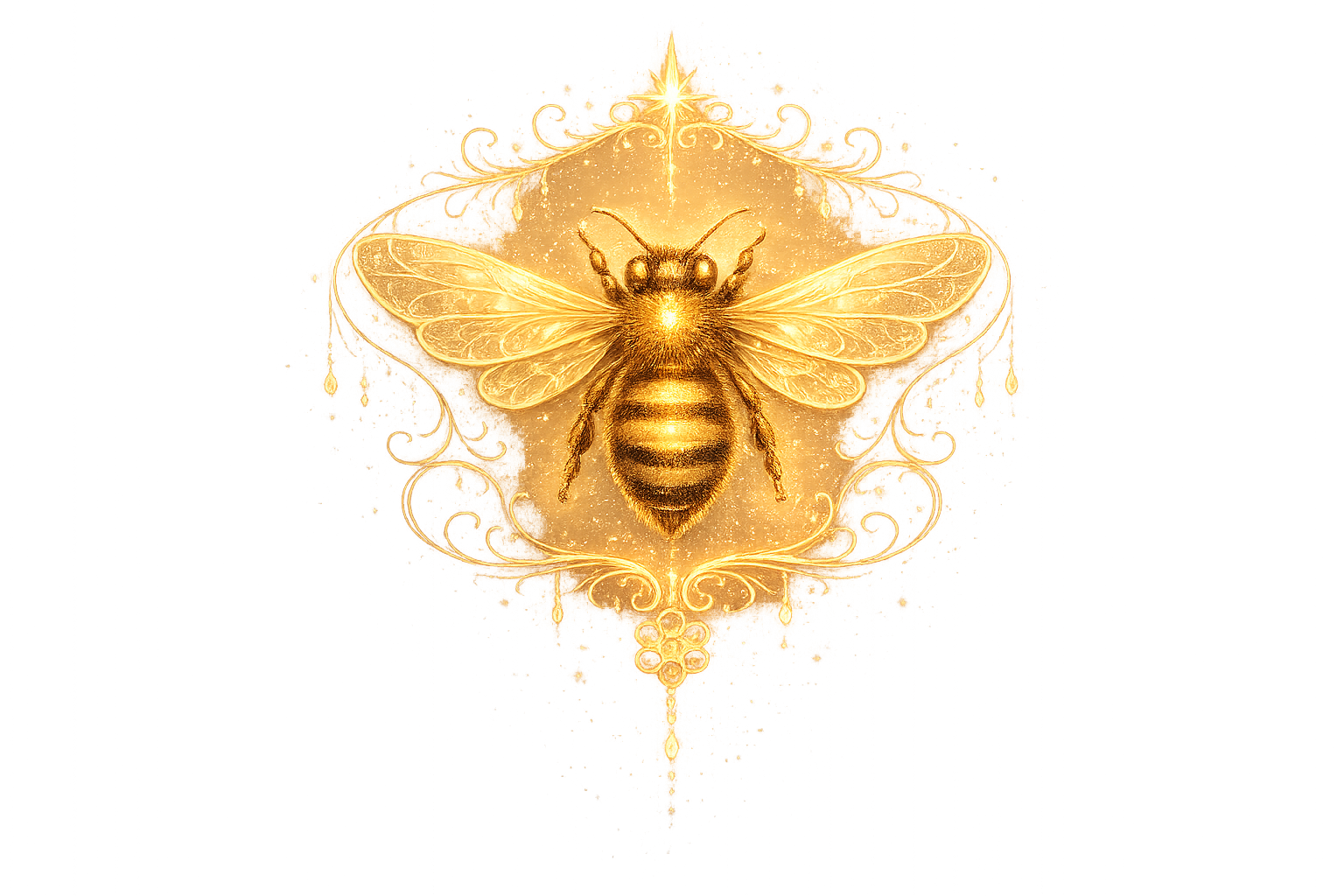
Honeybees and the hive itself offers us an extraordinary teaching about sisterhood, devotion, creation, reciprocity, vibration, fertility, abundance, and our interconnectedness with the natural world.
Jacqueline Freeman explores many of these themes beautifully in her book Song of Increase: Listening to the Wisdom of Honeybees for Kinder Beekeeping and a Better World.
She describes a bee-centered way of relating to honeybees, rooted in listening, observation, relationship, and reverence. She writes of approaching the bees through “kind observation,” and shares her experience of the hive as a kind of unity consciousness, where the life of each bee is woven into the life of the whole.
The honeybee reminds us that we belong to something larger than ourselves and that our individual gifts can contribute to the flourishing of the whole.
The Honeybee + the Sacred Feminine
There is something inherently feminine about the world of the honeybee. A healthy honeybee colony may contain tens of thousands of bees, and almost all of them are female. The queen is female and all of the worker bees are female. The male drones comprise a much smaller portion of the colony and have a very specific reproductive role.
The workers are literally sisters and half-sisters. They share the same mother, the queen, and together they create this vast feminine community. They build the honeycomb, feed and care for the young, gather nectar, pollen, make honey, clean the hive, protect the colony, regulate its temperature, communicate where food can be found, and care for the queen.
There is incredible devotion in the life of the worker bee. Throughout her life she moves through different roles according to the needs of the colony. There is a quality of wholehearted participation in the way bees live. Each individual contributes toward the continuation and flourishing of something larger. They put in 110%
Sisterhood allows us to create something together that none of us could create alone.
The Queen + the Creative Feminine
At the center of the reproductive life of the hive is the queen. Nearly every bee in the colony is her daughter, and during the height of the season she can lay enormous numbers of eggs each day.
The queen carries the generative potential of the colony, while thousands of workers create the environment that allows this new life to grow.
Jacqueline Freeman describes the different members of the hive through their sacred roles what she calls “The Song of Belonging,” exploring the queen, drones, workers, and young as participants in the life of one interconnected colony. Her larger teaching is that the bees seem to understand themselves through belonging.
There can be tremendous healing in remembering that we belong to the Earth, to one another, and to the larger web of life.
The Hive as Womb
Inside the hive it is dark, warm, enclosed, and vibrating with life. New bees develop within thousands of tiny wax chambers.
It is a place of gestation and transformation.
There is something profoundly womb-like in this image: life developing within darkness, held inside a vessel created by the feminine collective.
This brings us back to one of the great mysteries of the feminine path. So much creation begins invisibly. A seed is underground before it becomes a plant. A baby develops in darkness before birth. A dream, an idea, a calling or a new version of ourselves may be gestating long before anyone else can see it.
Honeybees in Ancient Egypt
Human relationship with honeybees reaches far back into the ancient world, and Egypt gives us some of the earliest known evidence of human connection with the bees.
Bees appear in Egyptian tombs and temples, and the bee itself became a significant hieroglyph.
So when we see bee imagery in Egyptian sacred architecture, we are seeing something with genuine cultural and royal significance.
The Egyptians also kept bees in cylindrical hives, harvested honey and used beeswax. Honey was precious as food, medicine, ritual offering and sacred substance.
There is also an Egyptian mythic tradition describing bees as arising from the tears of the sun god Ra. When the tears of Ra fell to Earth, they became bees, and the bees produced honey and wax. Here again, the bee carries a divine origin and becomes a bridge between the celestial and earthly worlds.
Hathor also enters the story for me because she represents so many of the qualities we associate with the bee: love, beauty, fertility, motherhood, music, pleasure, sexuality and joy. There are contemporary mystical traditions that say Hathor brought the honeybees to Earth from Venus.
Think of it: Hathor, Venus, flowers, bees, honey, fertility, motherhood, music and sweetness all belong to a similar archetypal landscape. There is something about the bee that continually draws us toward the mysteries of love, life and creation.
The Melissae: The Bee Priestesses of Ancient Greece
The sacred bee appears again in ancient Greece.
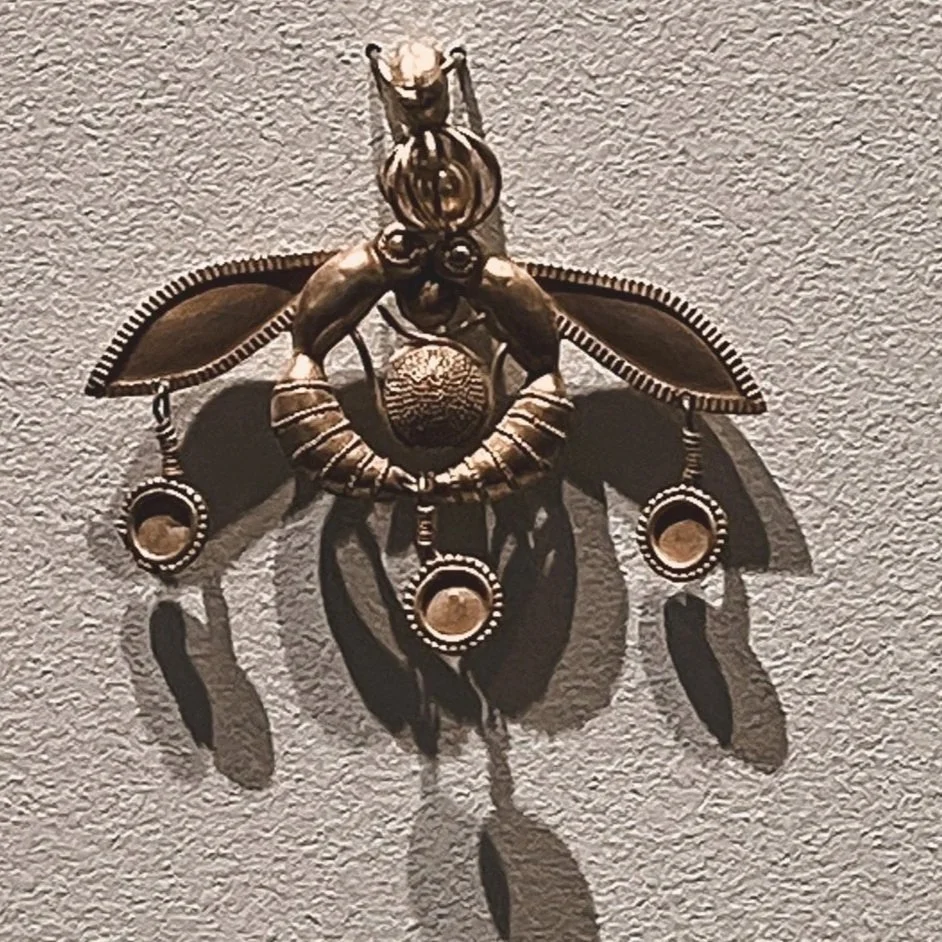
An ancient piece of jewelry from a museum in Crete
The Greek word melissa means honeybee, and Melissae means bees. Remarkably, Melissa also became a title associated with priestesses.
Ancient sources especially connect the name with priestesses and initiates of Demeter, the great Earth Mother and goddess of grain, fertility and agriculture. The term also appears in traditions connected with Artemis. I recently went to Crete and saw beautiful ancient gold jewelry that was found of a honeybee.
It makes sense when we consider what a bee does. She leaves the darkness of the hive and travels into the world. She enters the center of the flower. She gathers nectar and pollen. She carries fertility from one blossom to another. Then she returns to the sanctuary of the hive carrying what she has gathered back to her community.
This feels to me like a beautiful metaphor for the priestess.
The priestess enters deeply into life. She listens, observes and receives. She enters the mysteries. She gathers wisdom through her own experience and communion with the sacred, and then she returns to her community carrying something that can nourish others.
The bee gathers nectar and transforms it into honey.
The priestess gathers experience and transforms it into wisdom.
Bees, Dreaming + the Invisible World
Bees have also been associated in the ancient imagination with prophecy, divine inspiration and the mysterious realms of the goddess.
They are also connected to dreaming. Calling on the honeybees in dreams, I had a dream of a perspective from the bees
Jacqueline Freeman writes very personally about listening to the bees and receiving teachings through her relationship with them. Her book includes both practical observations of honeybee life and what she understands as direct communications from the bees.
Whatever language we use for that experience, I find the invitation meaningful: slow down, become receptive, pay attention, and allow the natural world to become a teacher.
The Waggle Dance + Sacred Reciprocity
Another extraordinary aspect of honeybee life is the way bees communicate where food can be found.
When a forager discovers an abundant source of nectar or pollen, she returns to the hive and performs what is known as the waggle dance. Her sisters gather around her, and through the direction and duration of the dance she communicates information about where the food source is located.
The dance often follows a figure-eight pattern. Scientists have shown that the angle of the central waggle portion communicates direction relative to the sun and that its duration conveys information about distance.
I love holding the figure eight symbolically as an image of reciprocity - giving and receiving.
The bee receives nectar from the flower, (like the rose) and as she receives, pollen collects on her body. She carries that pollen to another flower and helps the plant reproduce. The flower nourishes the bee, the bee fertilizes the flower, the bee brings nourishment home to the hive, and the hive sends more bees out into the landscape.
Giving becomes receiving and receiving becomes giving.
The figure eight becomes a beautiful symbol for this continuous circulation of nourishment.
Vibration, Sound + the Song of the Hive
Honeybees live in an extraordinary world of vibration.
Inside the hive there is very little light, so bees rely heavily on scent, touch, movement and vibration. Their movements send vibrations through the wax comb, and even the waggle dance produces measurable vibrational signals. Researchers have measured comb vibrations in the range of roughly 200 to 300 hertz during portions of the waggle dance.
This makes me think about sound healing and the ways vibration affects our own bodies.
We begin life in a womb filled with rhythm. We hear and feel the heartbeat of our mother. Sound moves through fluid and tissue. Later in life, we experience how music can change our emotional state, how chanting can shift our breathing and nervous system, and how singing together can create a feeling of connection within a group.
I love imagining the hive as an instrument, thousands of beings participating in a shared vibrational field.
And perhaps there is a teaching here for us about coherence. What happens when we come together and begin to resonate with one another? What happens when our individual voices become part of a larger song?
Sisterhood, Devotion + Sacred Work
The honeybees give themselves fully to the roles they are carrying. To something larger than themselves.
They continually respond to the needs of the community.
It makes me think about what it means to bring that same wholeheartedness to our own sacred work.
What are we willing to give ourselves to because we deeply love it? What work feels worthy of our life force? What becomes possible when our work is connected with service?
And within sisterhood, how might we learn from the hive? Every woman does not have to perform the same role. We each have different gifts, different seasons and different ways of contributing. Together, those contributions can create an ecosystem of support.
When the Bees Suffer: Colony Collapse + Our Relationship with the Earth
There is another side of honeybee wisdom that feels especially important for us to acknowledge.
Scientists now understand declining honeybee health as the result of
Feeding bees sugar/corn syrup
Scrambling genetics of queens and drones - Queen breeding
Introducing new colonies where they are not acclimated to the climate
Prevention of swarming which compromises the queen’s fertility, leading to the practice of replacing Queens
Stress by in-hive manipulation
Pesticide use and GMO fields
Monocropping all one variety and expecting the bees to pollinate
For example, let’s take large-scale monocropping. Imagine thousands of acres planted with a single crop. For a short period, an enormous amount of one type of flower may become available. When that bloom ends, the landscape may offer very little diverse forage. Bees thrive with access to varied flowers and the different nutrients they provide.
Modern agriculture has often prioritized maximum production, uniformity, control and efficiency. The bees remind us of another set of values: biodiversity, relationship, nourishment, responsiveness, reciprocity and respect for natural rhythms.
This is one place where honeybee wisdom becomes a teaching for our entire culture.
A living system needs diversity and relationship
A living system needs conditions that allow life to regenerate itself.
And when we begin restoring diverse habitats, reducing harmful pesticide exposure, planting flowers, supporting regenerative agriculture and approaching beekeeping with greater reverence for the natural needs of the colony, we participate in that regeneration.
The Bees + Our Own Survival
Our relationship with pollinators ultimately comes back to our own survival as well.
Around three quarters of the world's major food crop types depend at least partly on animal pollination, and pollinators affect approximately 35 percent of global crop production by volume. They contribute to the foods that give us so much of the beauty, color and nutritional diversity in our diets: fruits, berries, nuts, seeds and vegetables.
Their flourishing is connected to our flourishing.
Once again, we arrive at one of the central teachings of the bee: we are interconnected.
The Wisdom of the Honeybee
So when I contemplate honeybee wisdom, I think of the sacred feminine. I think of thousands of sisters living within a shared field of purpose. I think of the queen and the generative center of the hive. I think of the womb, gestation and creation taking place within darkness.
I think of vibration and the humming song of the hive.
And I think of sisterhood, belonging, devotion and sacred work.
The flower nourishes the bee. The bee pollinates the flower. The land nourishes the hive. The hive nourishes the surrounding land. Every part participates in the flourishing of the whole.
Perhaps the honeybee is inviting us to remember that we too belong within this web.
And so I invite you to reflect:
Where are you being called into deeper sisterhood?
What are you devoted to?
What sweetness are you gathering in your life, and what sweetness are you creating?
What is gestating within you?
Where could there be a greater balance of giving and receiving?
What is your unique role within the larger hive of your community? And how might you live in deeper reciprocity with the Earth that sustains us?
With love,
Meredith
If you’re curious to learn more about honeybees and priestess wisdom, consider joining us in
Enter Your Name and Email to Download our Program Guide: