Why Mary Magdalene Matters
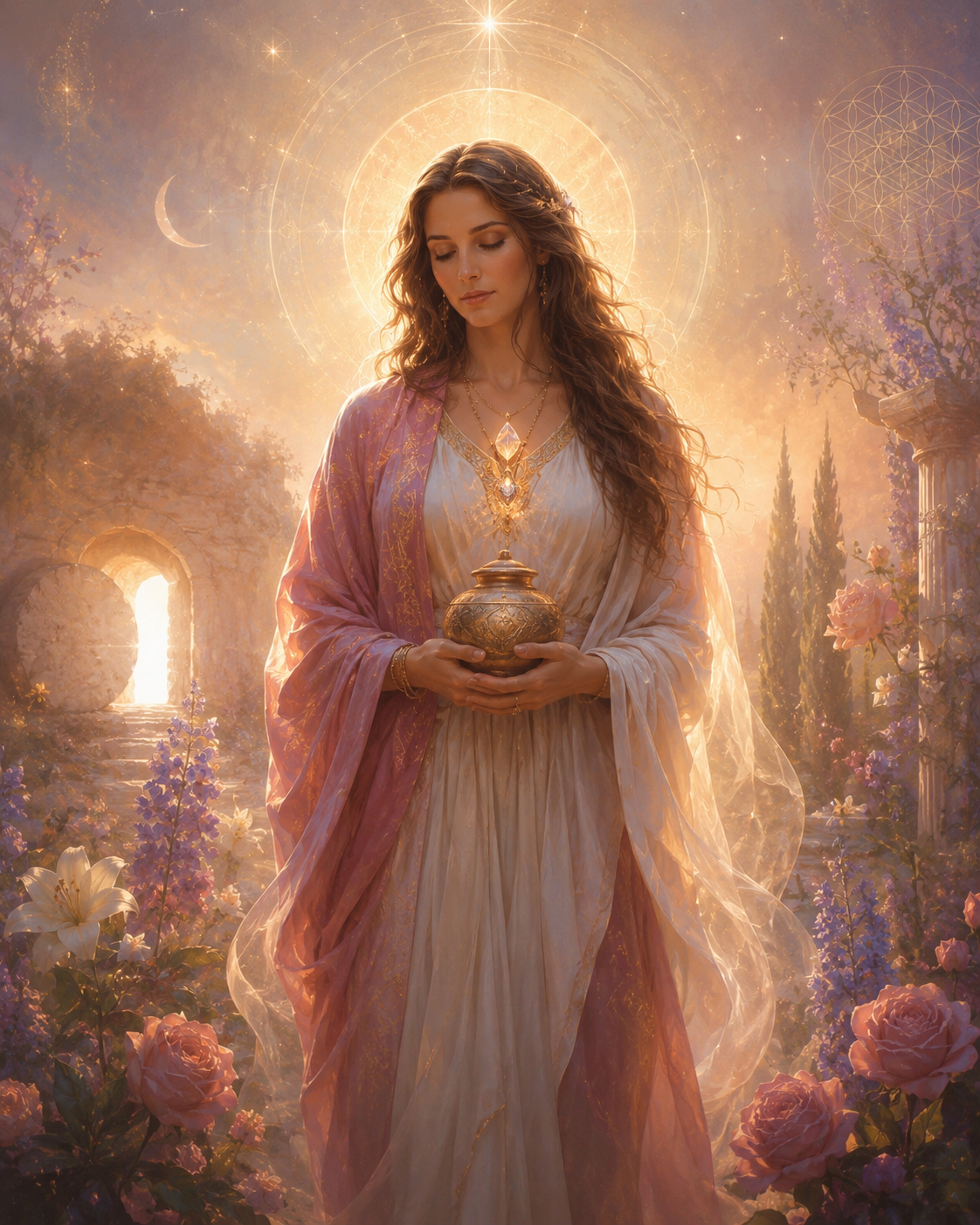
I was recently asked by someone who does not know much about Mary Magdalene why she matters so much to me.
Most people only know Mary Magdalene through the image of a penitent prostitute, from a narrative that has existed for centuries. That image has been preached, painted, repeated, and absorbed so thoroughly in the Western imagination that many still assume it must be true.
But that is not what the Gospel texts actually say.
And it is not how all of Christianity has remembered her.
The Unnamed Sinner: The Story Placed onto Mary Magdalene
One of the main sources of confusion comes from Luke 7:37–50, the story of an unnamed “sinful woman” who comes to Jesus weeping, bathes his feet with her tears, wipes them with her hair, and anoints him. It is a moving story of love, humility, and the power of forgiveness.
But the woman in that passage is unnamed.
The Gospel does not call her Mary Magdalene.
Then, immediately after this scene, Luke 8 introduces Mary Magdalene by name as a different woman, one of the women traveling with Jesus and supporting his ministry, from her own means. The text itself does not identify her with the unnamed sinner. That confusion came later in the Western church.
This turning point came in the year 591, when Pope Gregory the Great preached a homily that fused together multiple Gospel women in the Western imagination.
(Homily 33, 591 CE):
“She whom Luke calls the sinful woman, whom John calls Mary, we believe to be the Mary from whom seven demons were ejected according to Mark.”
From that point on, the unnamed sinner of Luke 7 and Mary Magdalene were increasingly read as one figure in the Latin church. Gregory’s sermon became one of the strongest forces behind the image of Mary Magdalene as a repentant sexual sinner, even though the biblical text itself does not make that identification.
That single sermon changed the symbolic place of Mary Magdalene in Christian memory.
Mary Magdalene’s authority as disciple, apostle, witness, and teacher became overshadowed by a story of sexual shame that actually does not exist in the Gospel texts.
It was only in 1969 the Vatican issued a liturgical clarification to not identify Mary Magdalene with Luke 7’s sinful woman, acknowledging that the Gospel texts do not support that identification. It was a very quiet but significant correction that effectively admitted: she should no longer be known through the prostitute narrative.
But it was a buried clarification.
A quiet correction in church documents.
Important, but not widely felt. It was the Catholic Church quietly acknowledging that Mary Magdalene was not to be identified as the sinful woman.
That the Gospel texts did not support calling her a prostitute.
That centuries of confusion had shaped her image.
In Eastern Orthodox Christianity Mary was always honored as equal to the Apostles.
They never portrayed her as a sinful woman or prostitute. She has long been honored as Myrrhbearer (bringing sacred oils to the burial site with Mother Mary) and Equal to the Apostles because of her witness to the resurrection.
That means the Western prostitute narrative was not an essential Christian memory. It was a particular Western invention, and the East preserved a much more intact remembrance of her dignity and apostolic role.
It’s possible without Mary Magdalene’s presence and witness to the resurrection, spreading the word of the Easter message, Christianity would not be what it is today.
She was among the few who remained steadfast when many of the disciples had fled.
I believe, Jesus (or Yeshua) as he was called in his time, chose her to carry on his message.
Many Christian traditions recount her traveling across the Mediterranean and bringing those teachings westward, preserving a memory of her as a spiritual teacher and leader.
Although she was remembered by many as faithful, steadfast, and entrusted with the Easter message, she was recast by the Catholic Church through the lens of sin and penitence.
And this is why she matters now…
Because what happened to Mary Magdalene has happened to women for centuries.
Our authority has been questioned.
Our words and witness have been doubted.
Our power has been reduced.
The Restoration in 2016
So this is why in 2016, when Pope Francis elevated her July 22 memorial to an apostolic feast day in the General Roman Calendar, placing it at the level of the other apostles, many women felt it.
The Vatican’s decree and accompanying article explicitly highlighted her as “apostle of the apostles,” and described her as an evangelizer of the central Easter message. The article also referred to her as an “apostle of the new and greatest hope.”
This was the day my recognition of Mary, and her story began to awaken. And I have deepened my historical understanding and spiritual connection with her for the last ten years.
What I see she holds for us now, for so many women:
She represents how so many women were mistreated by patriarchy, and her name being restored is a healing balm for all of us.
What happened to Mary Magdalene is not new.
A woman of spiritual understanding and authority had that authority taken away for hundreds of years. She was reduced to a story of shame.
How many women know this pattern in their own lives?
To be mislabeled, diminished. To have their power translated into something safer for the culture around them.
Restoring Mary Magdalene restores women’s authority.
It restores the memory that women were there from the beginning.
That women carried spiritual authority in the earliest movement of the faith.
In restoring her, we are also restoring the place of women. As equals. As spiritual leaders. As witnesses whose voices matter.
Beyond this, she embodies so much more.
A Template for What We Can Become
Mary Magdalene matters now because she offers us a template of what a human life can become when it is given fully to love.
Her Devotion is Unwavering
She is faithful all the way through.
She remains near the cross. She returns to the tomb. She stays close when so many others scattered.
Mary Magdalene stands at the very threshold and remains. She stays close through death, silence, and uncertainty, and because of that steadfast love, she becomes the first to receive the news that changes everything.
She is entrusted with the resurrection message and sent to carry it to the others. In this way, she becomes a foundation stone of the Christian story. It’s hard to know what Christianity would have become without her. She was among the few who remained and became one of the first witnesses to carry the resurrection message forward.
She Offers a Feminine Face of the Divine
For so long, women have tried to find themselves reflected in traditions shaped largely by male authority, male language, and male images of holiness.
She offers women a way to encounter the sacred through feminine form.
She reminds us of the power of the feminine: devotion and authority.
Tenderness and strength. Softness and power.
She Embodies Incredible Courage
Mary Magdalene’s courage was immense.
She stays at the cross when it was not necessarily safe to do so. She holds witness, vigil, prayer through Jesus’ death and resurrection. She refuses to leave.
Then she continues to use her voice and share his message during a time when it was dangerous to be speaking out as a woman.
She travels across unknown waters, across the Mediterranean to an unknown land, in a time when many of Jesus’ followers were being persecuted, and continued to share the teachings throughout France.
She Keeps Her Heart Open After Loss
She stands so close to loss, but I don’t believe she let it harden her.
When I reflect on her life after Jesus’ death, I don’t think she isolated herself in grief. I believe she allowed herself to be changed. She surrendered to a greater plan, knowing that Jesus was here for that greater plan, to touch the hearts of people who would come after him for thousands of years.
And I believe she chose to embody the teachings he passed on.
She invites us to keep our hearts open in the face of grief and suffering.
This too is part of her teaching. That forgiveness is the strength to remain open to love even through suffering.
Mary Magdalene embodies that strength.
~
So, this is why her name still stirs so many hearts.
Her story is a healing one for many.
She carries the memory of what could not be fully erased: Love.
With love,
Meredith

Interested in diving deeper into teachings like this?
Enrollment is open for the Way of the Priestess Initiation Program.
Enter your Name + Email to Download the Program Guide