What is the Significance of a Golden Ankh?
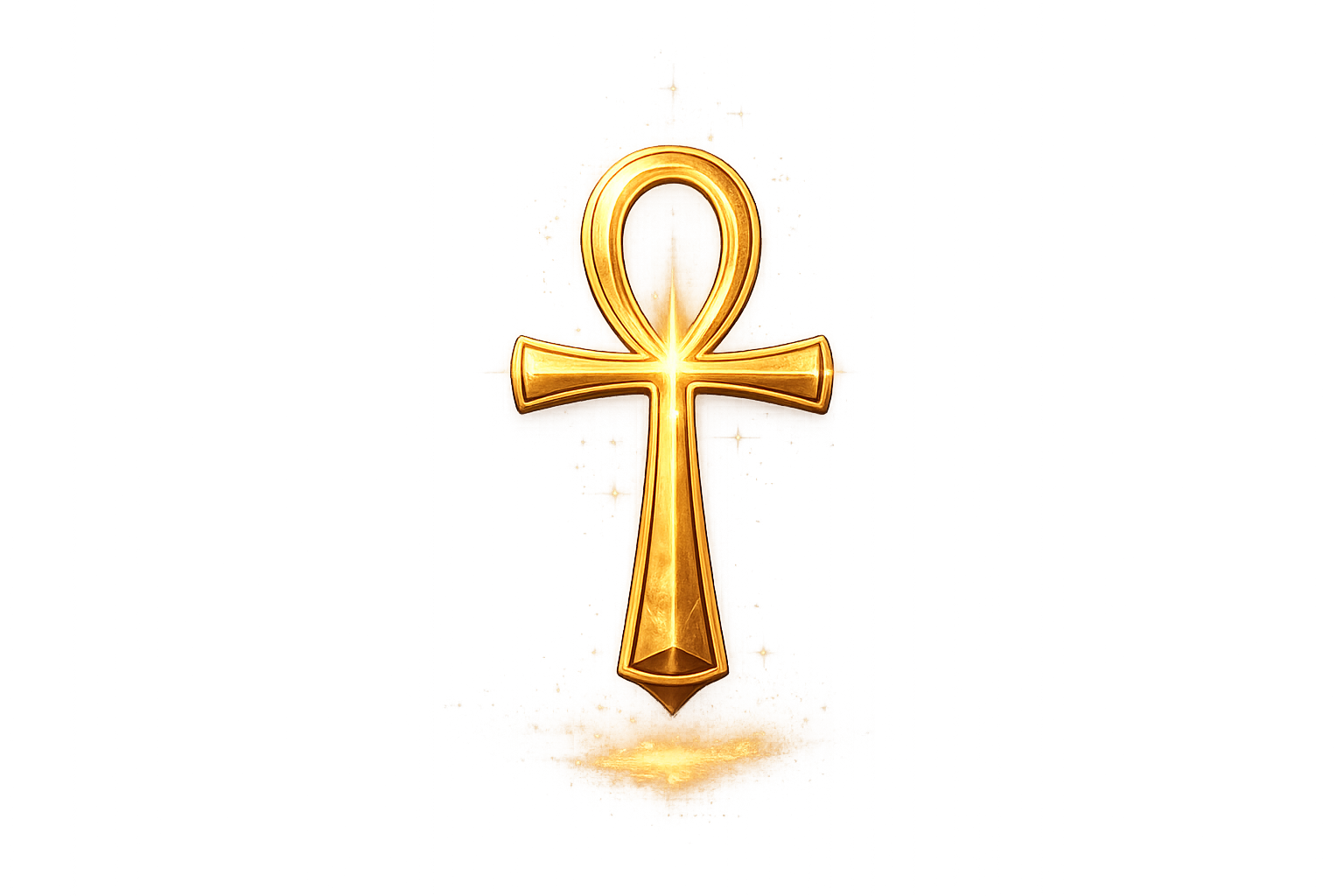
The ankh is one of the most recognizable and enduring symbols of ancient Egypt. Often called the key of life or the key of the Nile, the ankh appears in temple carvings, tomb paintings, amulets, and ritual objects spanning thousands of years. Frequently depicted in the hands of deities, the ankh symbolized life itself — eternal and divinely sustained life.
When people today speak of a Golden Ankh, they are often intuitively connecting to both the ancient symbolism of the ankh and the energetic qualities long associated with gold. Together, these form a powerful symbol of vitality, healing, and divine continuity.
The Ankh in Ancient Egypt: Life, Breath, and Eternity
In ancient Egyptian cosmology, the ankh represented life force. Gods and goddesses are commonly shown holding the ankh to the nose or lips of pharaohs, symbolizing the transmission of the “breath of life.” This gesture appears in temple reliefs and funerary art, suggesting that the ankh was understood as a conduit through which divine vitality flowed.
The ankh was also deeply associated with the afterlife. Egyptians believed life continued beyond death, and the ankh became a promise of renewal and immortality. It was frequently placed in tombs and worn as an amulet to ensure safe passage and continued vitality in the realms beyond the physical world.
Sacred Geometry and Symbolism
The shape of the ankh itself is meaningful. While scholars still debate its exact origin, several interpretations coexist:
The loop at the top is often associated with the sun, eternity, or the womb — the source of life.
The vertical line represents the masculine or the path of spirit descending into matter.
The horizontal crossbar symbolizes the earthly plane or the meeting of worlds.
Together, the ankh can be understood as a union of masculine and feminine principles, heaven and earth, spirit and body — a visual expression of harmony and wholeness. This union made it a powerful emblem for balance, regeneration, and sacred order (ma’at).
The Ankh as a Healing Tool
While there is no surviving ancient text that explicitly describes the ankh as a “healing tool” in the modern sense, there is strong symbolic evidence that it was associated with restoration and vitality. Egyptian medicine was inseparable from spirituality. Healing involved prayers, invocations, ritual gestures, and the presence of sacred symbols — all alongside herbal and physical treatments.
Priests and priestesses served as healers, and temple rituals often invoked the life-giving powers of the gods. The ankh, held by deities such as Isis, Osiris, and Sekhmet, symbolized divine energy flowing into the human realm. In this context, the ankh functioned as a symbolic transmitter of life force — an emblem of restoration, protection, and alignment with divine order.
Modern spiritual practitioners who work with ankhs as energetic tools are engaging in a contemporary interpretation — not a direct continuation of an ancient technique, but a resonance with the symbol’s original meaning: life, vitality, and sacred flow.
Why Gold Matters
Gold held profound significance in ancient Egypt. It was regarded as the symbolic, “flesh of the gods,” associated with the sun and with immortality. Unlike other metals, gold does not tarnish, corrode, or decay — making it a perfect symbol for eternity and divine essence.
When paired with the ankh, gold amplifies the symbolism. A Golden Ankh evokes the solar principle: illumination, vitality, consciousness, and divine presence embodied in form. For modern seekers, gold often represents higher frequency, spiritual refinement, and clarity. Historically, it signified what was eternal and unchanging.
Thus, the Golden Ankh can be understood as a symbol of eternal life force expressed through divine consciousness.
From Ancient Symbol to Modern Spiritual Practice
Today, people encounter the Golden Ankh in meditation, energy healing, jewelry, altar tools, and visionary experiences. While these uses are modern, they echo ancient themes: transmission of life force, remembrance of divine origin, and alignment between body, spirit, and cosmos.
In ancient Egypt, symbols were alive — imbued with meaning, intention, and power. To engage with the ankh today is to step into that symbolic language, where form carries consciousness and meaning shapes experience.
A Bridge Between Worlds
The enduring power of the ankh lies in its simplicity and depth. It reminds us that life is sacred, that vitality flows from a divine source, and that death is not an end but a transformation. The Golden Ankh, in particular, bridges earthly embodiment with eternal consciousness — a symbol of life remembered, renewed, and revered.
Whether approached historically, symbolically, or spiritually, the Golden Ankh continues to speak across time: Life is sacred. Life is eternal. Life flows through you.
If you are feeling called to sacred feminine symbols like the Golden Ankh, you may be drawn to learn more about our Year-and-a-Day Priestess Initiation Program