What Is the Camargue Cross? Meaning, Symbolism, and the Three Marys of Southern France
Along the windswept coastline of southern France, near where the Rhône River meets the sea, there is a symbol that quietly holds centuries of devotion, mystery, and story.
It is known as the Camargue Cross.
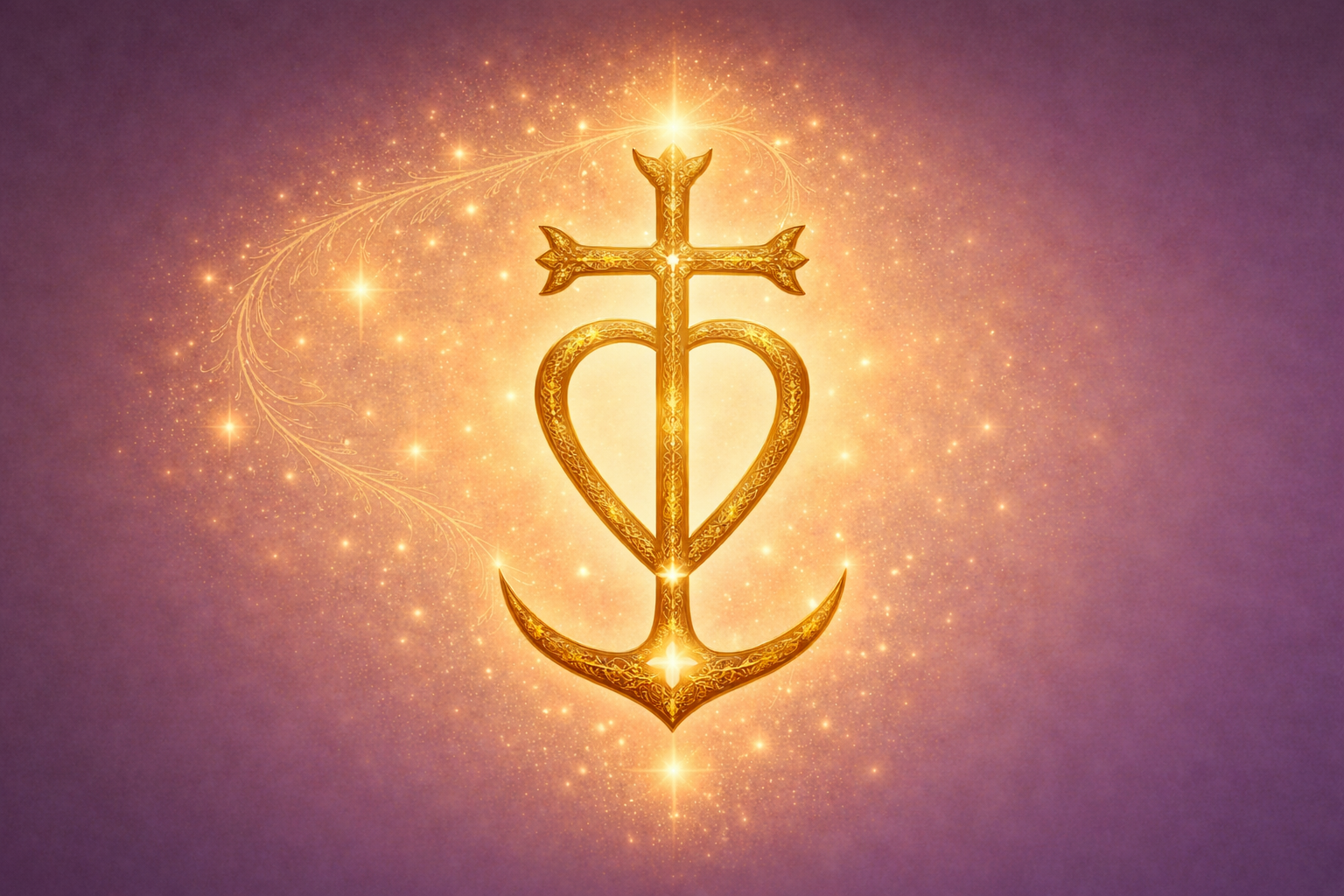
At first glance, it appears simple: a cross, an anchor, and a heart woven together into a single form. But like many sacred symbols, its meaning deepens the longer you sit with it.
The Camargue Cross is traditionally understood to represent three spiritual virtues:
Faith, Hope, and Love.
Or, in some interpretations: Faith, Hope, and Charity.
The Symbolism of the Camargue Cross
The Camargue Cross is composed of three elements:
The Cross — Faith
The upper portion represents faith—devotion to the divine, trust in something greater than oneself, and a willingness to walk a spiritual path even when the way is not fully clear.
The Anchor — Hope
The lower portion forms an anchor, symbolizing hope.
In a coastal region shaped by the sea, the anchor is deeply meaningful. It represents steadiness, grounding, and the ability to remain rooted even amidst uncertainty and change.
The Heart — Love (or Charity)
At the center is the heart, representing love—the force that binds and animates all things.
In some traditions, this third virtue is named not as love, but as charity.
Love vs. Charity — What’s the Difference?
The distinction between love and charity comes from translation and theological nuance.
The original Greek word used in early Christian texts is “agape”—a form of love that is unconditional, selfless, and rooted in divine care for all beings.
When translated into Latin, this became “caritas”, which is often rendered in English as charity.
But this doesn’t mean charity in the modern sense of giving or philanthropy.
Instead, charity (caritas) refers to:
a deep, unconditional love
a generosity of spirit
a willingness to give from the heart without expectation
So while “faith, hope, and love” may feel more familiar, “faith, hope, and charity” carries a slightly different tone, one that emphasizes love in action.
Behind this triad lives a story that has been passed down through the land itself, the story of the Three Marys.
The Three Marys of the Camargue
According to southern French tradition, after the death of Yeshua, a group of his close followers set off in a boat, into the Mediterranean Sea.
Among them were:
Mary Salome
Mary Jacobe (Mary of Cleophas or Clopas)
The boat made its way to the shores of what is now known as Saintes-Maries-de-la-Mer, in the Camargue region of France.
Mary Jacobe, sometimes called Mary of Cleophas, was closely connected to Jesus’ family. Tradition holds that she was the wife of Cleophas, a relative of Joseph, and the mother of several sons who became part of Christ’s early circle—including James the Less and Jude Thaddeus, who would later be known as apostles.
Mary Salome was the wife of Zebedee, a fisherman, and the mother of James the Greater and John—two of Jesus’ closest and most beloved disciples. From the very beginning, her sons left everything to follow him.
These women were present throughout Christ’s life—walking alongside him, tending to his needs, and supporting his ministry. The Gospels tell us they followed him, served him, and remained faithful, even at the foot of the cross when so many others had fled.
In addition to the three Marys it was thought that Mary’s siblings Martha and Lazarus were on the boat along with disciples Maximin (a devoted disciple of Mary Magdalene) and Sidonius (the man who Jesus healed from being blind). Sara, who became Saint Sara was also traveling with them. She was the chambermaid of one of the Marys, and thought to be of Egyptian, or gypsy and would later be honored by the Romani people as their patron saint.
While some legends say they were pushed out to sea without sail and without oars, others believe their journey was intentionally planned through trade ships of Joseph of Arimethea on tin trade routes of the Mediterranean sea.
When they arrived, the legends say that, with the help of Maximin, they formed a simple altar from the earth itself. And there, through prayer, a spring of fresh water emerged from the ground—a living source that still flows today beneath the church that was built near the shores.
Some of the group continued onward, traveling through Provence to share the teachings. But Mary Jacobe, Mary Salome, and Sara remained.
They built a small oratory on that sacred ground. They prayed. They lived quietly, devoted to the path they had carried across the sea.
Mary Jacobe, Mary Salome and Sara became deeply woven into the spiritual life of the place, honored, remembered, and loved.
Years passed. One by one, the two Marys completed their lives—Mary Jacobe first, and Mary Salome shortly after. They were buried near the spring, in the place where the church now stands. Later, Sara too would be laid to rest there. What remains of their bones are in the reliquary of the chapel.
This place has become a sacred pilgrimage place where each year, people gather at the edge of the sea to honor the Marys and Sara for their arrival—the crossing, the devotion, the mystery of being carried into a new land by their faith.
While the Marys and Sara remained in Saintes-Maries-de-la-Mer, Mary Magdalene journeyed inland to Marseilles and eventually near the caves of Sainte-Baume, while the other Marys remained near the sea.
The Camargue Cross emerged from this land of pilgrimage, holding not only early Christian symbolism, but also the spirit of those who carried the teachings forward.
A Living Symbol
What makes the Camargue Cross so powerful is that it is not only symbolic, it is lived.
It emerges from a place where land, sea, and story meet.
Where women—devotees, witnesses, carriers of a sacred lineage—arrived on unknown shores and continued the work they had been entrusted with.
Whether or not one takes the story literally, the essence remains:
Faith to walk the path
Hope to endure the unknown
Love to carry the teachings forward
The Camargue Cross invites us into a simple but profound question:
Where do I hold faith?
What anchors me?
And how does love move through my life?
Because ultimately, this symbol is not only something to understand, it is something to be lived.
If you’re curious to learn more about walking a sacred feminine path, consider joining us in:
Enter Your Name and Email Below to Download the Program Guide: